
Weekly Dev Recap #3 - Devblog #18: Gold Value, Monster Loot & the Economy Rework
· Development recap
A look at Monster Commodities, recognizable loot values and the Gold economy rework, with balance testing still in progress.
This development post records work and plans at the time of writing. It is not a release announcement; mechanics may change before reaching the live beta.
Hey everyone!
Last week, I explained how Item Bases and Runes let you find a good item and its enchantment separately. This week, I want to follow up on the rest of your loot, and why I'm rebuilding the Gold economy alongside it.
I want players at different levels to have a shared understanding of what Gold is worth. A stronger character can earn more from harder content, while familiar materials and services give you a way to judge what those earnings can buy.
What Monsters Leave Behind
Equipment and Runes are only part of what you'll find. I'm adding Monster Commodities: recognizable drops tied to monster families, such as Animal Pelt from wilderness creatures or Grave Dust from undeads.
The catalogue currently has 54 items across nine families, divided into Materials, Salvage, and Trophies. Each family has two ordinary Materials, one rare Material, two Salvage items, and a Trophy.
An Animal Pelt stays an Animal Pelt, regardless of the enemy level it came from. Pelts from different hunts stack together and have the same NPC sale value per unit. Harder content can improve your chances, give you more units, or unlock rarer materials.
In the current rework, you can sell these drops for Gold. I also plan to use them for equipment upgrades, crafting, delivery tasks, and other systems. Those uses still need to be built.
Keeping each material as one recognizable item also prepares it for future player trading. A player market is a later step, and its prices would depend on what players are willing to pay.
Keep, Sell, or Dismantle?
After a hunt, different drops give you different choices:
- A Base can be kept for a future Rune, sold, or dismantled for Metal.
- A Rune can be applied, saved, sold, or dismantled for Essence.
- Commodities can be sold to fund your next purchase, or stored if you want to keep them for their planned uses.
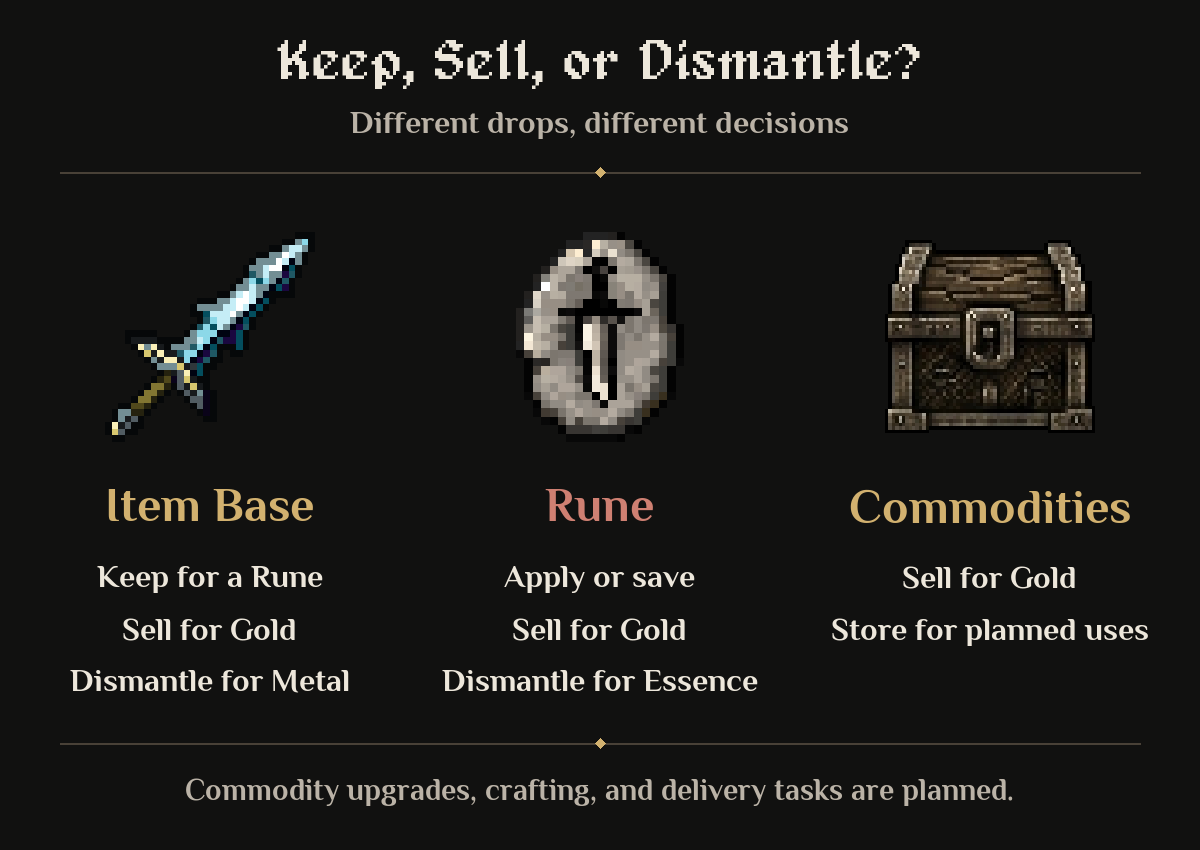
A hunt without a direct equipment upgrade can still help pay for training or a purchase, depending on what drops and what you choose to sell.
Giving Gold a Familiar Value
In the old economy, income, item prices, and progression costs all rose sharply with level. An amount that felt large early on could become ordinary a few dozen levels later. It was difficult to explain what someone's savings were worth without first asking their level.
The old direct Gold formula grew with the square of enemy level, pushing rewards into much larger numbers before other modifiers even came into play.
I'm reducing that growth and moving more of a hunt's value into loot. Direct Gold still increases with enemy level, and different activities still have different rewards. But finding and selling recognizable items should play a larger role in paying for your character's development.
Here's a simple example from the current configuration:
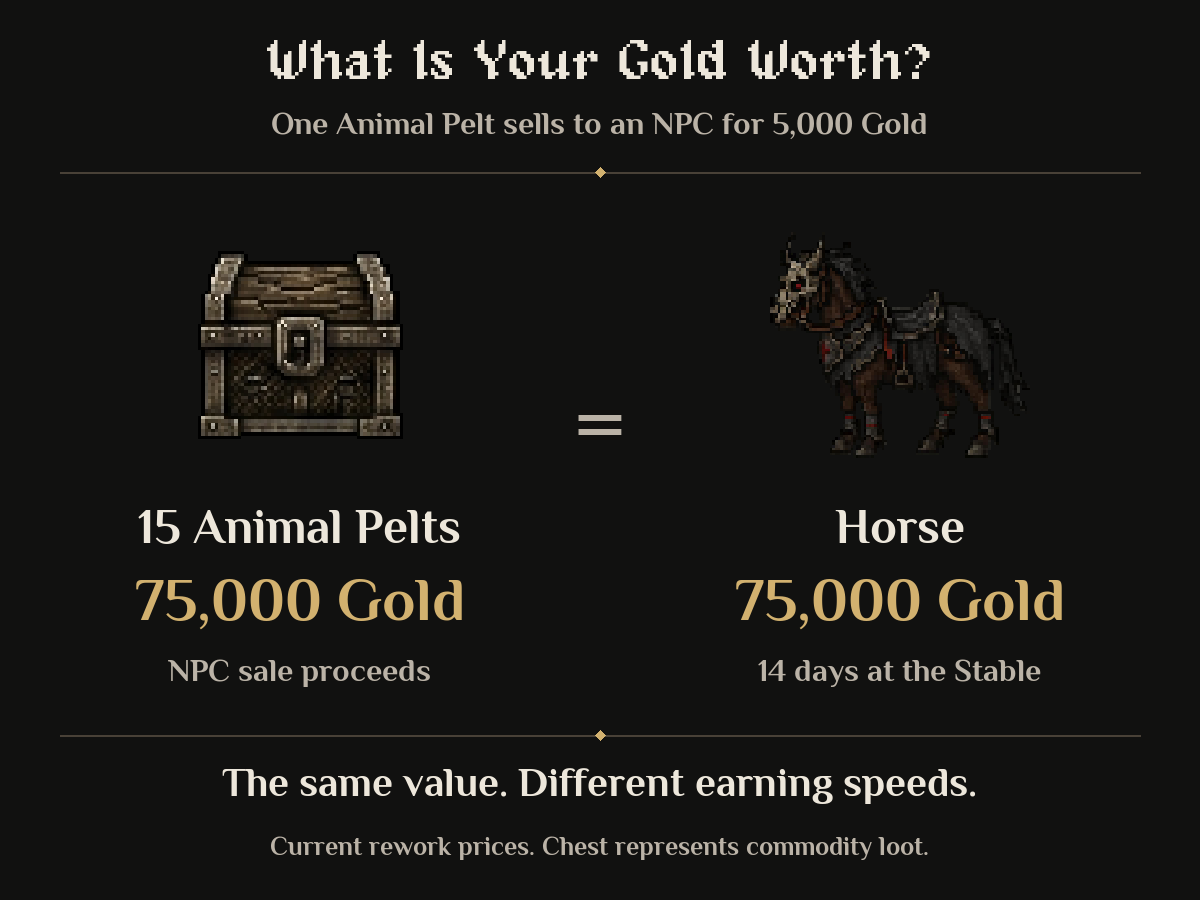
Fifteen pelts cover the Horse price. Gaining levels doesn't change that relationship. A higher-level character may collect those pelts sooner, but each one still contributes the same amount toward that expense.
This is the distinction I care about: predictable prices for the same goods, with room to earn more as you progress. Players have comparable stamina budgets, so the rewards from spending that stamina matter more than how quickly a character finishes an individual fight.
Here's how the parts fit together:
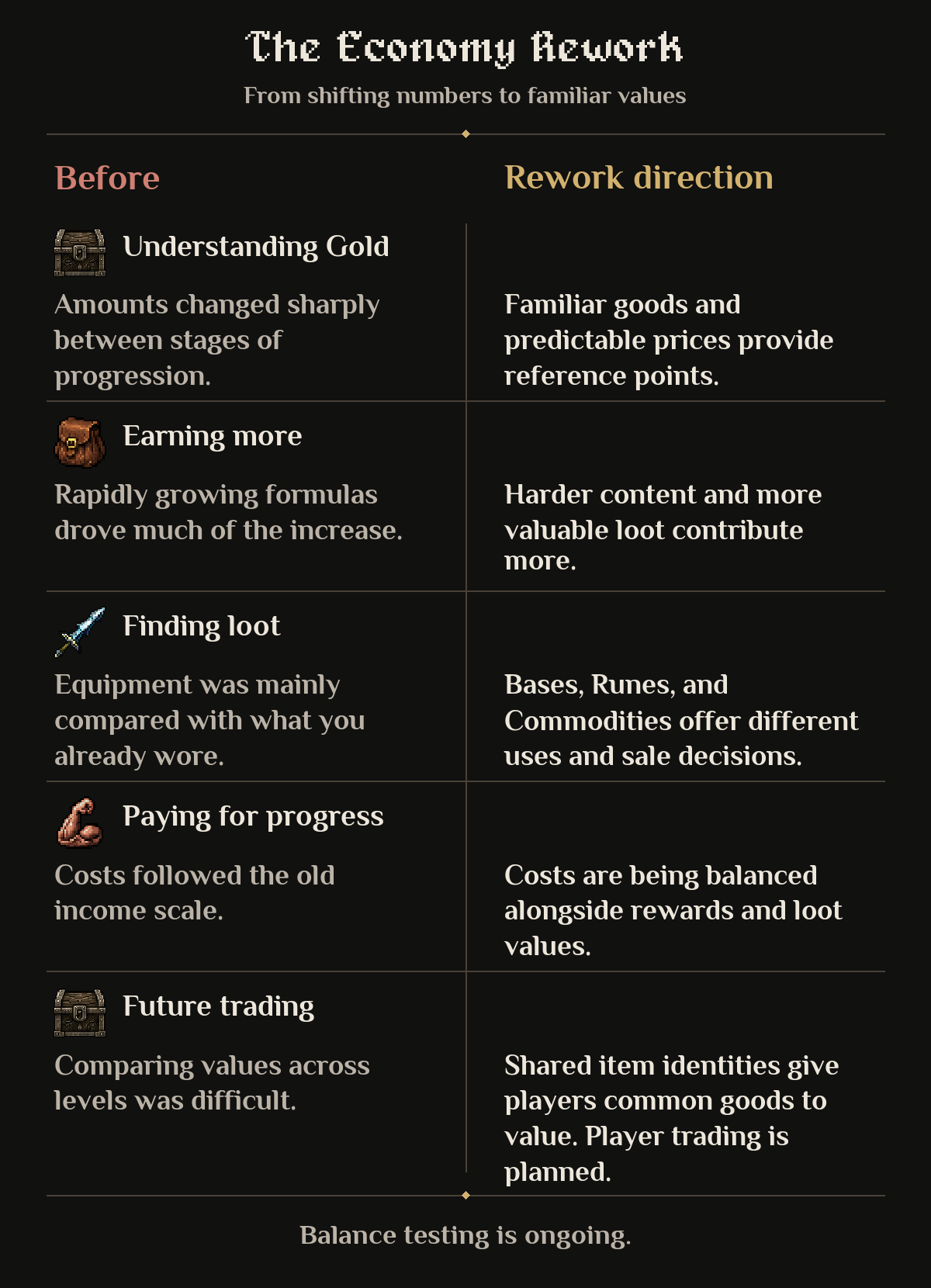
Some prices still need to grow. A stronger Base or Rune can be worth more because of its own level requirements and tier. Training becomes more expensive as the stat you're training increases. The same material, however, doesn't become more expensive simply because its owner gained a level.
Lower direct Gold rewards alone don't tell us whether progression is faster or slower. I need to compare them with loot sales and the costs of training, purchases, and services.
What Still Needs Balancing
I'm continuing to compare income and expenses across levels using the same stamina budget. The reports separate direct Gold from the potential sale value of loot, and regular income from rare windfalls and one-time Dungeon treasures.
Training affordability still needs work at some of the tested levels. Simulations help me find those gaps, but player testing will be needed to see how the choices feel in practice.
I want an Animal Pelt to remain a familiar find as your character grows. Next, I need to check how those earnings cover training and services throughout progression.
When you find a valuable material in an RPG, do you usually sell it to fund your next upgrade, or keep it for a future use?
Thanks for following the development, sharing your feedback, and supporting Realm of Dungeons.
To the next update!
-Chris 🖤
PS: A special thank you to my recent supporters:
Rick vill Kelevra Eviazu Someone Alpi Dogan Yammy Shiny Living Pokedex Project Vel Tuff Ivy Brock Cuilty Fabian Werner Lars Elmquist Tritonas eMeS Ponty Mython Patrick Wong fahad m Luis Mendez Grawn Traal Someone Someone Lorenzo Palumbo Felaxus GP vladdee The Love Chat Paul-Sean Heidemann dami dami Kevin Just Dave Pro Naeramarth HOLLOW SAINT Ivan Salman Quraishi
And a huge shoutout to my top supporters, forever grateful: #1 Scott #2 Spuddles #3 Brandon #4 Lars El #5 vladdee #6 Just Dave Pro #7 Pretense #8 Mason #9 Colera #10 Pretma #11 Kelevra
Browse all updates and devblogs · Discuss development on Discord